Ligament vs Tendon: Key Differences, Functions, Injuries, and Treatment
Ligaments and tendons are two important parts of the human body. Both are made of strong connective tissue, and both help people move, walk, lift objects, and stay active. However, they have different jobs. A ligament connects one bone to another bone, while a tendon connects a muscle to a bone.
Understanding ligament vs tendon differences can help you recognize common injuries, understand joint pain, and know when to seek medical care. Although ligament and tendon injuries can cause similar symptoms, they often happen for different reasons and may need different treatments.
For example, a person who twists their ankle may damage a ligament. Someone who repeatedly runs or jumps may develop a tendon problem. In both cases, pain, swelling, and difficulty moving can occur, but the affected tissue and recovery plan may be different.
This guide explains what ligaments and tendons are, how they work, how their injuries differ, and what you should know about common problems involving the knee, ankle, shoulder, and hand. It also explains how cartilage and joints fit into the picture.
The information is intended for readers in the United States and uses simple language to explain basic anatomy, injury prevention, diagnosis, and treatment. It is educational and does not replace advice from a qualified health professional.
What Is the Difference Between a Ligament and a Tendon?
The main difference between a ligament and a tendon is what each structure connects.
A ligament connects bone to bone and helps keep a joint stable. A tendon connects muscle to bone and transfers the force created by a muscle so that a body part can move.
Ligaments help prevent excessive movement at joints. Tendons help muscles pull on bones. Both support normal movement, but they serve different purposes.
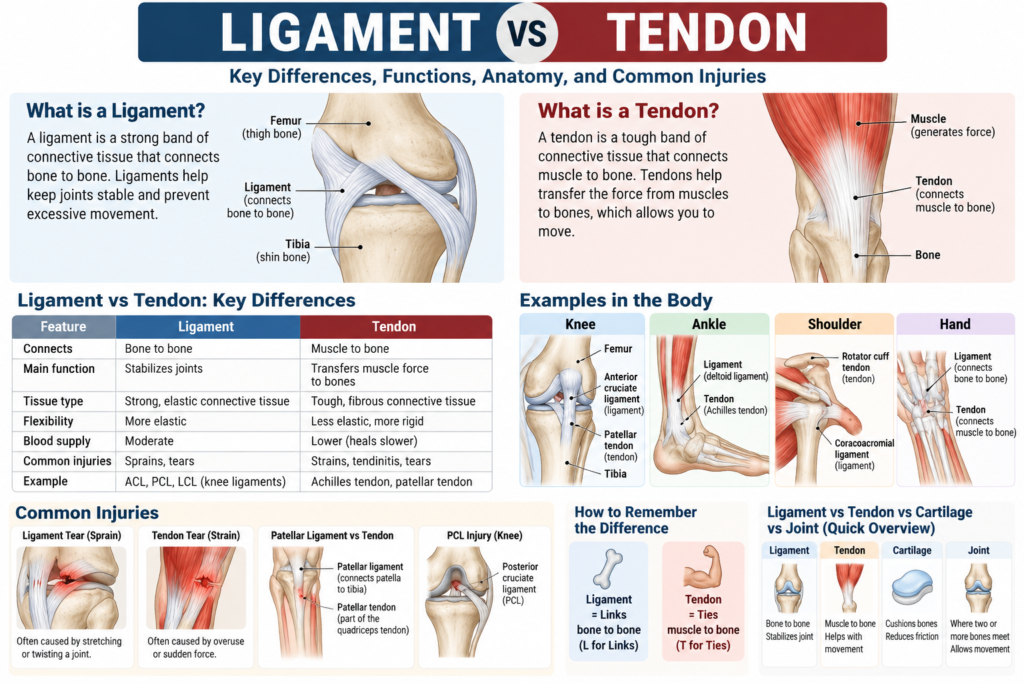
Ligament vs Tendon at a Glance
| Feature | Ligament | Tendon |
| Main connection | Bone to bone | Muscle to bone |
| Main function | Supports and stabilizes joints | Transfers muscle force to bones |
| Common injury | Sprain | Strain or tendon tear |
| Common causes | Twisting, falling, sudden joint movement | Overuse, heavy loads, sudden force |
| Common symptoms | Joint pain, swelling, instability | Pain with movement, tenderness, weakness |
| Examples | ACL, PCL, ankle ligaments | Achilles tendon, patellar tendon, rotator cuff tendons |
| Healing | Depends on the ligament, injury severity, and blood supply | Depends on the tendon, injury severity, and blood supply |
| Treatment | May include protection, rehabilitation, bracing, or surgery | May include load management, rehabilitation, medication, or surgery |
These are general differences. The symptoms and treatment of an injury depend on its location, severity, and cause.
What Is a Ligament?
A ligament is a strong band of connective tissue that connects bones. Most ligaments are found around joints, where two or more bones meet.
Ligaments help hold bones in the correct position. They also limit movements that could damage a joint. For example, ligaments in the knee help control forward, backward, and sideways movement.
Ligaments contain collagen fibers that provide strength. Some also contain elastic fibers that allow a limited amount of stretching. However, a ligament is not designed to stretch without limits.
When a ligament stretches too far or tears, the injury is called a sprain. A sprain may be mild, moderate, or severe.
Also Read: 220+ KFC Pick Up Line That Are Funny, Clever, Cute, and Flirty
Examples of ligaments include:
- The anterior cruciate ligament (ACL) in the knee.
- The posterior cruciate ligament (PCL) in the knee.
- The lateral collateral ligament (LCL) in the knee.
- The deltoid ligament on the inner side of the ankle.
- The scapholunate ligament in the wrist.
Ligaments are essential for joint stability. Without them, some joints would move too far or become unstable during everyday activities.
What Is a Tendon?
A tendon is a strong band or cord of connective tissue that attaches a muscle to a bone. Tendons transfer force from contracting muscles to the skeleton.
When a muscle contracts, it creates tension. The tendon carries that tension to the bone, allowing a joint to move. This is how people bend their elbows, straighten their knees, lift their arms, and push off the ground when walking.
Tendons also contain collagen fibers arranged to withstand pulling forces. Their structure allows them to handle repeated loads, although excessive stress can cause damage.
Common examples of tendons include:
- The Achilles tendon at the back of the ankle.
- The patellar tendon below the kneecap.
- The quadriceps tendon above the kneecap.
- The rotator cuff tendons in the shoulder.
- The flexor tendons in the fingers.
- The peroneal tendons along the outer ankle.
- The tibialis anterior tendon at the front of the ankle.
A tendon injury may develop gradually from repeated stress or occur suddenly during an activity. Inflammation, tendon degeneration, and tearing are different problems, so the correct diagnosis matters.
What Connects Muscle to Bone?
The answer is a tendon.
Tendons act as the link between muscles and bones. When a muscle contracts, the tendon transfers that force to a bone and helps produce movement.
For example, the quadriceps muscles at the front of the thigh help straighten the knee. Their force passes through the quadriceps tendon to the kneecap and then through the patellar tendon to the shinbone.
This system allows the knee to straighten when a person stands up, walks, climbs stairs, or kicks a ball.
What Connects Bone to Bone?
The answer is a ligament.
Ligaments connect bones and help stabilize joints. For example, the ACL connects the thighbone to the shinbone inside the knee. It helps control the movement of the shinbone relative to the thighbone.
A damaged ligament may allow a joint to move more than it should. This can cause a feeling that the joint is loose or may give way.
How to Remember Ligament vs Tendon
A simple memory trick can make the difference easier to understand:
- Ligament links bones.
- Tendon transfers tension from muscle to bone.
Think of a ligament as a stabilizing connection and a tendon as a force-transmitting connection.
Another way to remember the difference is to focus on the first question you would ask about the tissue. Does it hold two bones together at a joint? That is a ligament. Does it carry the pull of a muscle to a bone? That is a tendon.
This distinction is useful when learning anatomy, studying sports injuries, or trying to understand a doctor’s explanation of a joint problem.
Ligament vs Tendon vs Cartilage vs Joint
Ligaments, tendons, cartilage, and joints work together, but they are not the same thing. Understanding their roles helps explain why injuries in the same area can cause different symptoms.
What Is a Joint?
A joint is a place where two or more bones meet. Joints allow different types of movement, from wide movements at the shoulder to small movements between bones in the hand.
The knee, shoulder, ankle, wrist, and hip are examples of joints. Some joints move freely, while others allow very little movement.
A joint may contain cartilage, ligaments, a joint capsule, and other structures. Some joints also contain a layer of tissue called the synovial membrane, which produces synovial fluid to help reduce friction.
What Is Cartilage?
Cartilage is a firm, smooth connective tissue that covers the ends of bones in many movable joints. It helps the bones glide against each other and spreads pressure across the joint surface.
Cartilage is different from both ligaments and tendons. It does not primarily hold bones together or transfer muscle force. Instead, joint cartilage reduces friction and helps protect the surfaces of bones during movement.
Cartilage has a limited ability to repair itself because it has no direct blood supply. The extent of healing depends on the type, location, and depth of the damage.
Cartilage damage can occur through injury, repeated stress, or age-related changes. Osteoarthritis is one condition in which joint cartilage gradually breaks down.
Joint vs Ligament vs Tendon vs Cartilage
| Structure | What it does | Example |
| Joint | Where bones meet and movement occurs | Knee joint |
| Ligament | Connects bones and supports joint stability | ACL |
| Tendon | Connects muscle to bone and transfers force | Achilles tendon |
| Cartilage | Provides a smooth, protective joint surface | Knee articular cartilage |
A joint is the overall connection between bones. Ligaments help stabilize it, tendons help move it, and cartilage helps the joint surfaces glide smoothly.
This explains why knee pain may come from more than one structure. A person can have a ligament sprain, a tendon problem, cartilage damage, or a combination of these conditions.
Ligament vs Tendon vs Cartilage: Which Is Stronger?
There is no single answer because strength depends on the tissue’s size, structure, location, and the type of force applied.
Tendons are designed to handle strong pulling forces. Ligaments are designed to resist forces that could move a joint beyond its normal limits. Cartilage is designed to withstand compression and provide a low-friction surface.
Comparing these tissues by strength alone can be misleading. Each is adapted to a different job, and damage to any of them can affect movement.
Ligament vs Tendon Pain: How Do the Symptoms Differ?
Ligament vs tendon pain can be difficult to tell apart because both types of injuries may cause pain, swelling, stiffness, and reduced movement.
The location of the pain and the activities that make it worse can offer useful clues. However, symptoms alone cannot confirm which tissue is injured.
Signs of a Ligament Injury
A ligament injury often happens after a sudden movement, fall, collision, or twist. The joint may become painful or swollen soon after the injury.
Common symptoms include:
- Pain around a joint after twisting or impact.
- Swelling or bruising.
- Difficulty bending or straightening the joint.
- A feeling that the joint is loose or unstable.
- Trouble putting weight on the injured leg.
- A popping sound during some serious injuries.
A sprain can involve stretching, partial tearing, or complete tearing of a ligament. A severe injury may cause major joint instability.
Signs of a Tendon Injury
A tendon injury may happen suddenly or develop slowly after repeated use. The pain often becomes worse when the attached muscle works.
Common symptoms include:
- Pain when moving against resistance.
- Tenderness along a tendon.
- Stiffness after resting.
- Pain during running, jumping, lifting, or gripping.
- Swelling around the tendon.
- Weakness when using the affected muscle.
For example, Achilles tendon pain may become noticeable during walking or running. A rotator cuff tendon problem may cause shoulder pain when lifting an arm.
Tendon pain does not always mean that the tendon is inflamed. Long-lasting tendon problems may involve changes in the tissue itself, often called tendinopathy.
Can You Tell the Difference at Home?
You can look at the circumstances of the injury, but you should not rely on a home test to make a diagnosis.
Pain that begins after a joint twists may suggest a ligament injury. Pain that increases when a particular muscle contracts may suggest a tendon problem.
However, a single accident can damage several structures at once. A knee injury, for example, may affect ligaments, tendons, cartilage, or bone.
If the pain is severe, the joint feels unstable, swelling develops quickly, or you cannot use the affected body part normally, seek medical assessment.
Torn Ligament vs Torn Tendon: What Is the Difference?
A torn ligament is damaged tissue that normally connects bones. A torn tendon is damaged tissue that normally connects a muscle to a bone.
Both injuries can range from small tears to complete ruptures. The effect on movement depends on the structure involved.
Also Read: 200+ Gay Pick Up Lines That Actually Get Replies: Funny, Cute, Cheesy, Smooth, and Flirty Lines
What Happens When a Ligament Tears?
A torn ligament may reduce the stability of a joint. The knee may feel as though it will give way, or the ankle may feel weak when walking on uneven ground.
The injury may be described as mild, moderate, or severe. Some partial tears heal with appropriate protection and rehabilitation. Other injuries, especially those that cause major instability, may need specialist treatment or surgery.
An ACL tear is a common example of a serious knee ligament injury. It often occurs during activities that involve sudden stopping, turning, or landing.
What Happens When a Tendon Tears?
A torn tendon may cause pain, weakness, and difficulty performing a particular movement.
A complete tendon rupture can prevent a muscle from transferring force effectively to a bone. For example, a complete Achilles tendon rupture can make pushing off the foot difficult.
A quadriceps tendon rupture may make it difficult or impossible to straighten the knee actively. A rotator cuff tendon tear may weaken the shoulder and make lifting the arm difficult.
Some tendon tears need surgery, while others can be managed without an operation. The decision depends on the tendon, the size of the tear, the person’s activity needs, and the examination findings.
Can Ligaments and Tendons Break?
People sometimes search for terms such as “broken ligament” or “ligament broke.” In everyday speech, these usually refer to a stretched or torn ligament, not a broken bone.
A ligament can tear completely, but it does not break in the same way a bone fractures. Tendons can also tear or rupture.
An injury may occasionally involve both a soft-tissue tear and a bone fracture. That is one reason a medical examination is important after a significant accident.
How Long Does Healing Take?
There is no single recovery time for all ligament and tendon injuries.
A mild sprain may improve within days or weeks. A severe ligament tear may require several months of rehabilitation. Tendon problems can also take weeks or months to improve, especially if the tissue has been damaged for a long time.
Recovery depends on the location and severity of the injury, blood supply, age, general health, treatment, and the demands placed on the tissue.
Returning to sport too early can increase the risk of another injury. Progress should be based on restored strength, movement, balance, and function rather than pain alone.
Ligament vs Tendon in the Knee
The knee is a useful example of how ligaments and tendons work together. It is a complex joint that allows bending and straightening while helping the body support weight.
The knee contains four major stabilizing ligaments, several important tendons, cartilage, and the menisci, which are pads of fibrocartilage that help distribute loads.
Major Ligaments in the Knee
<AsyncImageGroup query={[“anatomical illustration anterior cruciate ligament posterior cruciate ligament knee labeled”,”medical illustration medial collateral ligament lateral collateral ligament knee anatomy”]} aspectRatio=”5:4″ layout=”bento”/>
The four major knee ligaments are:
- Anterior cruciate ligament (ACL): Helps control forward movement and rotation of the shinbone relative to the thighbone.
- Posterior cruciate ligament (PCL): Helps prevent the shinbone from moving too far backward.
- Medial collateral ligament (MCL): Supports the inner side of the knee.
- Lateral collateral ligament (LCL): Supports the outer side of the knee.
An injury to one of these ligaments may cause pain, swelling, or instability. A PCL injury can occur when the shinbone is forced backward, such as during a direct impact to the front of the shin while the knee is bent.
A PCL sprain may be mild or severe. Some people can walk with a PCL injury, so the ability to walk does not rule it out.
Major Tendons Around the Knee
The quadriceps tendon connects the quadriceps muscle group to the kneecap. The patellar tendon, also commonly called the patellar ligament in anatomical descriptions, connects the kneecap to the tibia, or shinbone.
These structures work together to straighten the knee.
The hamstring tendons at the back of the knee help bend it. Other tendons around the knee also help control leg movement and stability.
Patellar Ligament vs Tendon: Are They Different?
The terms patellar tendon and patellar ligament can cause confusion.
The structure below the kneecap is commonly called the patellar tendon in clinical practice. In some anatomical terminology, it is called the patellar ligament because it connects the patella to the tibia.
Both names refer to the same structure. Its role is to transmit force from the quadriceps mechanism through the kneecap to the shinbone, helping straighten the knee.
The name does not mean that the structure has two different functions or that a person has two separate tissues in that location.
Ligament vs Tendon vs Cartilage in the Knee
Different knee structures can cause similar symptoms.
| Structure | Possible problem | Common clues |
| Ligament | ACL, PCL, MCL, or LCL sprain or tear | Injury after twisting or impact; possible instability |
| Tendon | Patellar or quadriceps tendinopathy or tear | Pain with jumping, stairs, or knee straightening |
| Cartilage | Articular cartilage damage | Joint pain; symptoms depend on the damaged area |
| Meniscus | Tear in the knee’s fibrocartilage pad | Pain along the joint line, sometimes catching or locking |
| Joint lining | Inflammation or excess fluid | Swelling and stiffness |
These clues overlap. For example, swelling and pain may occur with both a ligament tear and cartilage damage.
What Causes a Swollen Knee?
A swollen knee may result from an injury, inflammation, arthritis, infection, or excess fluid in the joint.
The term knee effusion means an abnormal buildup of fluid inside the knee joint. People may also use the phrase “water on the knee.”
A sudden swollen knee after an accident can indicate bleeding inside the joint, particularly after some serious ligament injuries. A gradual buildup of fluid can occur with arthritis or other joint problems.
Do not assume that every swollen knee is caused by a ligament tear. A clinician may need to examine the knee and decide whether imaging or fluid testing is necessary.
What Does Knee Popping Mean?
Knee popping can occur for several reasons. Some harmless sounds happen when gas bubbles move in joint fluid or when tendons move over nearby structures.
Popping accompanied by sudden pain, rapid swelling, locking, or instability is more concerning. A pop during a twisting injury may occur with an ACL tear, but the sound alone cannot confirm the diagnosis.
Seek medical care if the popping starts after an injury or comes with significant pain or difficulty bearing weight.
What Type of Joint Is the Knee?
The knee is mainly a synovial hinge-type joint. It primarily bends and straightens, but it also allows a limited amount of rotation.
Its movement depends on the coordination of bones, ligaments, tendons, cartilage, muscles, and joint fluid. Damage to one structure can affect the function of the others.
Ligament vs Tendon in the Ankle
The ankle needs both flexibility and stability. Ligaments help hold the ankle bones in the correct position, while tendons move the foot and help control balance.
Common Ankle Ligament Injuries
An ankle sprain often happens when the foot rolls inward or outward unexpectedly. This can stretch or tear the ligaments that support the joint.
The lateral ligaments on the outside of the ankle are commonly injured when the foot rolls inward. A more severe injury may cause swelling, bruising, tenderness, and difficulty walking.
The deltoid ligament supports the inner side of the ankle. It is strong and is less commonly injured than the outer ankle ligaments, although significant force can damage it.
Common Ankle Tendon Injuries
The Achilles tendon connects the calf muscles to the heel bone. It helps a person push off the ground during walking, running, and jumping.
The peroneal tendons run along the outer ankle and help control foot movement and stability. The tibialis anterior tendon helps lift the front of the foot.
Tendon problems may develop from repeated running, sudden increases in exercise, or a direct injury. Achilles tendinopathy often causes pain and stiffness near the back of the heel or lower calf.
How Can You Tell Which Ankle Structure Is Injured?
An ankle sprain often follows a twisting movement and may cause swelling around the joint. A tendon problem may cause pain along the path of the tendon, especially when the related muscle is used.
However, these patterns are not reliable enough to diagnose the injury without an examination. An ankle fracture can also resemble a sprain.
If you cannot take several steps, have severe pain, notice a deformity, or have numbness or a cold foot, seek urgent medical assessment.
Ligament vs Tendon in the Shoulder
The shoulder has a wide range of movement, so it relies on muscles, tendons, ligaments, and joint structures to remain stable.
Shoulder Ligaments
Shoulder ligaments connect bones and support the shoulder joints. They help control movement and prevent excessive displacement.
The coracoacromial ligament forms part of the protective arch above the shoulder’s rotator cuff. Other ligaments support the joint capsule and connections around the collarbone.
A shoulder ligament injury may occur after a fall, collision, or dislocation. Symptoms depend on the location and severity of the damage.
Shoulder Tendons
The rotator cuff is a group of four muscles and their tendons that help move and stabilize the shoulder. Rotator cuff tendons can become irritated, develop long-term changes, or tear.
Common symptoms include pain when lifting the arm, discomfort at night, and weakness during overhead activity.
Shoulder tendon problems can resemble arthritis, bursitis, or other conditions. A physical examination helps narrow down the cause.
Why the Difference Matters
A ligament injury mainly affects the structures that support a joint. A tendon injury can affect the ability of a muscle to move or stabilize that joint.
Both may cause shoulder pain, but the treatment plan depends on the exact diagnosis. Rehabilitation often focuses on restoring comfortable movement, muscle strength, and shoulder control.
Ligament vs Tendon in the Hand and Wrist
The hand and wrist contain many small ligaments and tendons. Their coordinated function allows people to grip, type, write, play instruments, and perform detailed tasks.
Ligaments in the Hand
Ligaments connect the small bones of the wrist and hand. They help keep these bones aligned while allowing controlled movement.
The scapholunate ligament connects two wrist bones called the scaphoid and lunate. A tear can cause wrist pain, swelling, weakness, or clicking.
A significant ligament injury may affect grip strength and wrist stability. Some injuries need early assessment to prevent lasting problems.
Tendons in the Hand
Flexor tendons help bend the fingers, while extensor tendons help straighten them.
A tendon injury may make it difficult to bend or straighten one or more fingers. A cut can damage a tendon even if the skin wound appears small.
Sudden loss of finger movement, an open wound over a tendon, or severe swelling should be assessed promptly. Do not force a finger to move if a serious tendon injury is suspected.
Also Read: 300+ Dirty Pick Up Lines for Her: Funny, Cute, Smooth, Cheesy, and Flirty Rizz Lines
Common Causes and Risk Factors for Ligament and Tendon Injuries
Ligament and tendon injuries can affect people of all ages. They are common among athletes, but they can also happen during normal daily activities.
Sudden Injuries
Sudden injuries may happen when a person falls, twists a joint, lifts a heavy object, or changes direction quickly.
Examples include:
- Rolling an ankle while walking on uneven ground.
- Twisting a knee while playing basketball.
- Falling onto an outstretched hand.
- Lifting a heavy object without proper control.
- Jumping and landing awkwardly.
- Experiencing a direct impact during contact sports.
A sudden injury may stretch or tear a ligament, strain a tendon, or damage more than one structure.
Overuse Injuries
Overuse injuries develop when a tendon or other tissue repeatedly handles more stress than it can recover from.
Common examples include Achilles tendinopathy in runners, patellar tendinopathy in jumping athletes, and rotator cuff problems in people who perform repeated overhead movements.
The risk may increase when someone suddenly increases workout intensity, changes training surfaces, or returns to exercise after a long break.
Other Risk Factors
Factors that may increase injury risk include poor movement control, previous injuries, inadequate recovery, certain medical conditions, and some medications.
Age-related changes can affect tendon strength and tissue repair. Some medical conditions, including diabetes, can also affect tendon health.
These factors do not mean an injury is unavoidable. Appropriate training, gradual increases in activity, and early attention to persistent symptoms can help reduce risk.
How Are Ligament and Tendon Injuries Diagnosed?
A healthcare professional usually starts by asking how the injury happened and examining the affected area.
The goal is to identify the damaged structure, assess injury severity, and check for other problems such as fractures or joint instability.
Physical Examination
The examination may include checking:
- Where the pain is located.
- Whether swelling or bruising is present.
- How far the joint can move.
- Whether a muscle can produce normal force.
- Whether the joint feels stable.
- Whether sensation and circulation are normal.
A clinician may perform specific movement tests to assess individual ligaments or tendons. These tests should not be copied at home after a serious injury because forcing a painful joint can make the problem worse.
Is a Knee X-Ray Enough?
A knee X-ray can help identify a fracture, certain bone injuries, or changes caused by arthritis. It generally does not show a ligament or tendon tear directly.
Depending on the suspected injury, a clinician may recommend additional imaging.
- MRI: Provides detailed images of ligaments, tendons, cartilage, and other soft tissues.
- Ultrasound: Can assess certain tendons and may show tendon movement or tears.
- CT scan: May be useful for selected bone injuries or complex fractures.
Not every injury needs imaging. The decision depends on the examination and the possibility of a serious underlying problem.
Treatment for Ligament and Tendon Injuries
Treatment depends on the injured tissue, the severity of damage, the person’s overall health, and the activities they need to perform.
Many mild injuries improve without surgery. Serious tears, complete tendon ruptures, fractures, or injuries causing major instability may need specialist care.
What to Do Immediately After an Injury
For a recent injury, consider these general steps:
- Stop the activity that caused the pain.
- Protect the injured area from further stress.
- Apply an ice pack wrapped in a cloth for short periods to help manage pain and swelling.
- Elevate an injured arm or leg when practical.
- Use compression only if appropriate, making sure it does not cause numbness, tingling, color changes, or increased pain.
- Arrange medical assessment if symptoms are severe or the injury affects normal movement.
Do not put ice directly on the skin. Avoid tightly wrapping an injured limb, and do not use a brace as a substitute for medical assessment when a serious injury is possible.
Medication and Pain Relief
Some people use over-the-counter pain relievers to manage discomfort. However, these medicines are not safe for everyone.
Nonsteroidal anti-inflammatory drugs, such as ibuprofen, may be unsuitable for people with certain kidney problems, stomach ulcers, bleeding risks, or medication interactions. Ask a healthcare professional or pharmacist which option is appropriate for you.
Pain relief does not repair a torn ligament or tendon. It should support recovery rather than encourage you to continue an activity that may worsen the injury.
Physical Therapy and Rehabilitation
Rehabilitation is often an important part of recovery.
A physical therapist may recommend gentle movement, progressive strengthening, balance exercises, and activity-specific training. The plan should match the injured tissue and stage of healing.
Ligament rehabilitation often focuses on restoring joint stability, balance, and control. Tendon rehabilitation often uses carefully increased muscle loading to improve the tendon’s ability to handle everyday and athletic demands.
Exercises should progress gradually. If pain or swelling becomes significantly worse after exercise, the plan may need adjustment.
When Is Surgery Needed?
Surgery may be considered when a tendon is completely ruptured, a ligament injury causes significant instability, or a serious injury does not respond adequately to appropriate nonsurgical treatment.
For example, some ACL injuries require reconstruction, while other ligament injuries can heal with rehabilitation and protection.
Tendon surgery may involve reconnecting torn tissue to a bone or repairing the damaged tendon. The decision depends on the injury and the person’s functional needs.
A diagnosis of a tear does not automatically mean surgery is necessary.
Ligament and Tendon Injuries After Knee Replacement Surgery
Knee replacement surgery replaces damaged joint surfaces with artificial components. It is commonly used to reduce pain and improve function in people with severe knee arthritis.
However, knee replacement does not eliminate the need for healthy muscles, tendons, and supporting tissues.
Can Ligaments and Tendons Be Injured After Surgery?
Yes. Soft-tissue problems can occur during recovery or after a fall or sudden movement. Symptoms such as new swelling, weakness, or pain should be assessed by the surgical team.
After total knee replacement, rehabilitation often includes gradual walking, knee movement, and strengthening exercises. The exact plan depends on the operation and the surgeon’s instructions.
Exercises to Avoid After Knee Replacement
There is no universal list of exercises that every patient must avoid forever. Restrictions depend on the procedure, recovery stage, and individual medical advice.
During early recovery, avoid forcing painful movements, lifting heavy loads without clearance, or returning to high-impact sports before your care team approves.
Follow the rehabilitation instructions provided by your surgeon and physical therapist. Do not begin aggressive knee mobility exercises or change your activity plan based only on online advice.
Do Knee Braces and Compression Sleeves Help?
A knee support sleeve may provide comfort and a sense of support for some people. A more structured knee brace may be recommended for selected ligament injuries.
However, a compression sleeve cannot repair a torn ligament or tendon. The right device depends on the diagnosis, and an overly tight brace may affect circulation or irritate the skin.
People recovering from knee replacement should ask their surgical team before adding a brace or compression device.
When Should You Seek Medical Care?
Seek urgent medical care if an injury causes severe pain, obvious deformity, major swelling, numbness, a cold or discolored limb, or an inability to bear weight or use the affected body part.
A sudden pop followed by major weakness or loss of movement can indicate a serious ligament or tendon injury.
A hot, red, swollen joint accompanied by fever also needs urgent evaluation because a joint infection can be dangerous.
Arrange a medical appointment if pain persists, swelling returns repeatedly, the joint gives way, or symptoms interfere with normal activities. Early assessment can help prevent further damage and guide appropriate rehabilitation.
How to Prevent Ligament and Tendon Injuries
No prevention plan can eliminate every injury, but a few habits can lower risk.
Warm Up Before Exercise
Begin with several minutes of easy movement before intense exercise. Increase the intensity gradually so your muscles and connective tissues can adapt.
Increase Training Slowly
Avoid sudden jumps in running distance, lifting weight, jumping volume, or workout frequency. Allow time for recovery between demanding sessions.
Strengthen Supporting Muscles
Strength training can improve movement control and help distribute forces across joints. Exercises should target the muscles needed for your sport or daily activities.
Also Read: 300+ Ginger Pick Up Lines: Funny, Cute, Flirty, Cheesy and Smooth Rizz
Improve Balance and Technique
Balance training may help reduce some ankle injuries. Practicing safe landing, turning, and lifting techniques can also improve control.
Wear Suitable Footwear
Shoes should fit properly and match the activity. Supportive footwear may help some people, but it cannot prevent every ankle or tendon injury.
Take Persistent Pain Seriously
Do not repeatedly train through worsening pain. Adjusting activity early may prevent a minor problem from becoming a longer-lasting injury.
Frequently Asked Questions About Ligament vs Tendon
1. Can an MRI tell the difference between a torn ligament and a torn tendon?
Yes. An MRI can often distinguish a ligament tear from a tendon tear because the two structures have different locations and attachments. It can also show other damage, including certain cartilage injuries. However, MRI is not required for every injury, and results must be interpreted alongside the physical examination.
2. Can you have a ligament or tendon injury without swelling?
Yes. Mild injuries and some chronic tendon problems may cause pain without obvious swelling. The amount of swelling depends on the tissue involved, the injury’s severity, and how much time has passed. The absence of swelling does not rule out a tear.
3. Do ligament and tendon injuries increase the risk of arthritis?
Some serious joint injuries can increase the risk of developing osteoarthritis later. For example, significant knee ligament injuries may occur alongside cartilage damage, and joint instability can affect how forces move through the joint. A tendon injury does not automatically cause arthritis, and the long-term risk varies by injury type.
4. Can a ligament or tendon tear again after it heals?
Yes. A previous injury can increase the risk of another injury, especially if strength, balance, flexibility, or movement control have not fully recovered. Some tissues also heal with scar tissue. A gradual return to activity and appropriate rehabilitation can help reduce the risk of reinjury.
5. Which specialist treats ligament and tendon injuries?
A primary care clinician, sports medicine physician, orthopedic specialist, or physical therapist may be involved, depending on the injury and local referral system. A suspected major tear may require an orthopedic evaluation. A physical therapist can help with rehabilitation when it is medically appropriate.
Conclusion
Understanding ligament vs tendon differences makes it easier to understand how the body moves and why certain injuries happen.
Ligaments connect bone to bone and help stabilize joints. Tendons connect muscle to bone and transfer force to produce movement. Cartilage protects joint surfaces, while joints provide the connections that allow bones to move in controlled ways.
A ligament injury often follows a twist or impact and may cause joint instability. A tendon injury may develop from repeated stress or sudden overload and can cause pain or weakness during muscle movement. However, symptoms can overlap, and more than one structure may be damaged at the same time.
The knee, ankle, shoulder, hand, and wrist all depend on healthy ligaments and tendons. Correct diagnosis, suitable protection, and gradual rehabilitation are important for recovery. Some injuries improve without surgery, while severe tears may require specialist treatment.
If you experience significant pain, rapid swelling, loss of movement, or joint instability, seek medical advice rather than trying to diagnose the injury yourself. Understanding the difference between ligaments and tendons is a useful first step toward protecting your joints and making informed decisions about your health.