K2 vs Everest: Height, Difficulty, Death Rate, Location, Cost, and Climbing Comparison
When people search for K2 vs Everest, they are usually asking one main question: which mountain is harder and more dangerous to climb?
The short answer is that Mount Everest is higher, but K2 is generally considered more technically difficult and more dangerous for climbers. Everest rises to 8,848.86 meters (29,031.7 feet), while K2 reaches 8,611 meters (28,251 feet). That means Everest is about 237.86 meters (780 feet) higher than K2.
Yet height alone does not determine how difficult a mountain is. Route steepness, rock and ice climbing, weather, avalanche danger, rescue options, altitude, and the amount of commercial support all matter.
K2 is the world’s second-highest mountain and is famous for its steep terrain, severe weather, and demanding climbing routes. Everest, the world’s highest mountain, is also extremely dangerous, but its most popular routes have a much larger expedition infrastructure.
This detailed K2 vs Everest comparison explains their height, location, technical difficulty, death rates, climbing routes, costs, history, risks, and the reasons K2 has earned a reputation as one of the world’s most difficult major mountains.
K2 vs Everest: Quick Comparison
| Feature | K2 | Mount Everest |
| Height | 8,611 m (28,251 ft) | 8,848.86 m (29,031.7 ft) |
| World ranking | 2nd highest | Highest |
| Location | Pakistan-China border region | Nepal-Tibet/China border |
| Mountain range | Karakoram | Himalayas |
| Common climbing routes | Abruzzi Spur, other technical routes | South Col, North Ridge |
| Technical difficulty | Very high | High |
| Weather | Extremely severe | Extremely severe |
| Altitude above 8,000 m | Extensive | Extensive |
| Commercial support | Limited compared with Everest | Extensive on main routes |
| Overall reputation | More technically demanding | Higher but generally more accessible on standard routes |
| First successful ascent | 1954 | 1953 |
| Common nickname | Savage Mountain | Often called the world’s highest mountain |
The comparison is important because K2 vs Everest difficulty is not simply a question of which mountain is taller. Everest wins in height, while K2 presents a more technical and complex climbing challenge on its standard route.
K2 vs Everest Height
The first major difference in the K2 vs Everest height comparison is easy to understand.
Mount Everest is 8,848.86 meters high, according to the jointly announced Nepal-China elevation measurement. K2 is 8,611 meters high.
The difference is:
8,848.86 − 8,611 = 237.86 meters
So, Everest is approximately 238 meters taller than K2.
In feet, the difference is about 780 feet.
How high is K2?
The height of K2 is 8,611 meters, or approximately 28,251 feet above sea level.
K2 is therefore the second tallest mountain in the world.
How high is Mount Everest?
The height of Mount Everest is 8,848.86 meters, or approximately 29,031.7 feet.
It is the highest point on Earth above sea level.
K2 vs Everest height in kilometers
For readers searching for the height of Mount Everest in kilometres, Everest is approximately 8.849 km high.
K2 is approximately 8.611 km high.
The difference is about 0.238 km.
Although that difference sounds large, it does not explain why K2 is considered harder. A mountain can be lower but much more difficult because of its terrain.
Also Read: 200+ Pick Up Line for a Guy: Funny, Cute, Flirty, Smooth & Charming Lines
K2 vs Everest Size: Which Mountain Is Bigger?
The answer depends on what “bigger” means.
If you mean elevation above sea level, Everest is bigger.
If you mean technical climbing difficulty, K2 is generally considered more demanding.
If you mean the physical size of the entire mountain, there is no simple single measurement that allows a useful K2 vs Everest size comparison.
Mountain height is only one measurement. A mountain’s slopes, ridges, valleys, glaciers, rock faces, and surrounding terrain also contribute to its overall physical character.
This is why saying “Everest is higher, so Everest must be harder” is misleading.
Where Is K2 Located?
One of the most common questions is where is K2?
K2 is located in the Karakoram mountain range in the region administered by Pakistan and China. The mountain lies near the border between the two countries.
The most commonly used approach for climbing K2 is from the Pakistan side.
K2 is associated with Gilgit-Baltistan in Pakistan and lies within the Karakoram system.
Where is Mount Godwin-Austen?
K2 is also known as Mount Godwin-Austen, although K2 remains its most widely recognized name.
The name Godwin-Austen refers to Henry Haversham Godwin-Austen, a British surveyor and geographer associated with early exploration and surveying of the Karakoram.
Searches such as “where is Mount Godwin Austen located” therefore refer to K2.
Where Is Everest Located?
Mount Everest is located in the Himalayas along the border between Nepal and Tibet, which is part of China.
The southern side is in Nepal, while the northern side is in Tibet.
The two major climbing approaches are therefore:
- Nepal’s southern route
- Tibet’s northern route
The Nepal route is the most famous commercial climbing route.
K2 vs Everest Map and Location
A K2 vs Everest map shows an important geographic difference.
Everest is part of the Himalayan mountain system, while K2 belongs to the Karakoram.
Both mountains are in the broader high-mountain region of Asia, but they are hundreds of kilometers apart.
K2 lies farther northwest than Everest.
The difference in location also affects access, logistics, weather patterns, climbing infrastructure, and rescue operations.
For someone researching K2 location, it is useful to remember:
K2 = Karakoram = Pakistan/China
Everest = Himalayas = Nepal/China
K2 vs Everest: Which Is Harder to Climb?
The question K2 vs Everest which is harder to climb has a fairly clear answer among experienced mountaineers.
K2 is generally considered harder to climb than Everest.
That does not mean Everest is easy. Everest is an extremely dangerous high-altitude mountain, and reaching its summit requires extensive preparation, physical fitness, acclimatization, technical ability, and careful decision-making.
However, K2 presents greater technical challenges on its main climbing route.
Why is K2 so difficult?
Several factors contribute to K2’s difficulty:
- Steeper terrain
- Technical rock and ice climbing
- Complex route finding
- Severe weather
- Frequent objective hazards
- Limited safe resting areas
- Difficult descent
- High altitude
- Avalanche and serac danger
- Limited rescue options
K2’s upper mountain is especially demanding.
The mountain is famous for steep sections, exposed ridges, and difficult climbing conditions. The descent after reaching the summit can be just as dangerous as the ascent.
K2 vs Everest Technical Difficulty
The K2 vs Everest technical difficulty comparison is one of the most important parts of this subject.
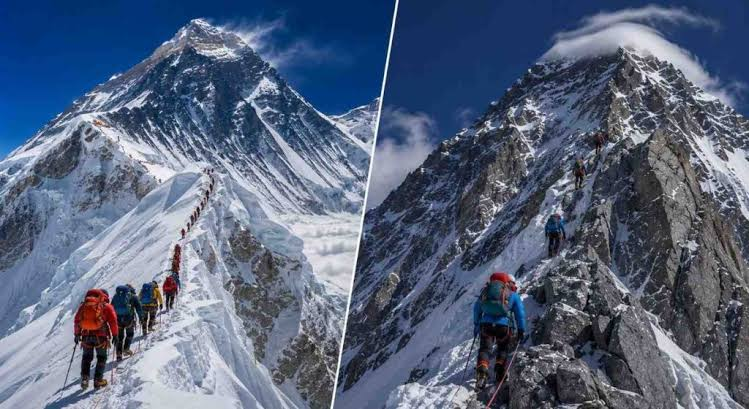
On Everest’s most popular southern route, climbers encounter glaciers, ladders, steep snow and ice, rock sections, and the famous Khumbu Icefall. However, a large commercial climbing industry has developed around this route.
Experienced Sherpa guides and expedition teams provide substantial logistical support.
K2’s standard Abruzzi Spur route is much more technical.
Climbers must negotiate steep rock and mixed terrain, exposed traverses, snow and ice, and demanding upper sections.
The mountain offers fewer opportunities for comfortable movement and recovery.
The Bottleneck on K2
One of K2’s most famous hazards is the Bottleneck, a steep couloir beneath large serac formations.
Climbers passing this area face a combination of steep climbing, falling ice, exposure, and the risk of being trapped beneath unstable seracs.
The danger becomes particularly serious because climbers often encounter these challenges at extreme altitude.
K2 vs Everest Routes
Everest South Col Route
The standard Everest route from Nepal follows a broad progression:
- Base Camp
- Khumbu Icefall
- Western Cwm
- Lhotse Face
- South Col
- Southeast Ridge
- Everest summit
This route is difficult but has been climbed by thousands of people.
It also has extensive expedition infrastructure.
K2 Abruzzi Spur
K2’s most commonly attempted route is the Abruzzi Spur.
The route includes several technically difficult sections and steep terrain.
Important features include:
- House’s Chimney
- Black Pyramid
- Shoulder
- Bottleneck
- Upper mountain slopes
- K2 summit ridge
The route demands strong technical climbing skills and excellent judgment.
K2 vs Everest Death Rate
The death rate K2 vs Everest is complicated because different sources may calculate it differently.
A common mistake is to take the number of deaths and divide it by the number of successful summits. That produces a ratio, but it does not represent the true probability that an individual climber will die.
A better comparison requires looking at:
- Deaths
- Attempts
- Summits
- Climbers exposed to risk
- Historical periods
- Route conditions
- Changes in climbing technology
- Changes in expedition support
Historically, K2 has had a substantially higher fatality-to-summit ratio than Everest.
However, the frequently repeated statement that “one out of every four K2 climbers dies” should not be presented as a current personal probability. It is based on historical ways of calculating the death-to-summit relationship and can be misleading.
K2 death rate
K2 has historically had a much higher fatality ratio than Everest.
Its reputation comes from a combination of technical difficulty, severe weather, limited climbing windows, and dangerous terrain.
The mountain has experienced multiple major disasters throughout its climbing history.
Everest death rate
Everest has also claimed hundreds of lives.
However, its large expedition industry, established routes, improved forecasting, better equipment, and extensive support have changed the risk profile over time.
The death rate on Everest is therefore not a fixed number.
K2 vs Everest fatality rate: Why numbers can be misleading
Suppose a mountain has 100 deaths and 1,000 successful summits.
That gives a simple death-to-summit ratio of 10%.
But it does not mean every climber had a 10% chance of dying.
Some climbers may have made multiple attempts. Some deaths occurred during descent. Others may have died during years when conditions or climbing practices were very different.
For that reason, responsible sources should distinguish between:
Death-to-summit ratio and probability of death per climber or attempt.
These are not identical measurements.
K2 Deaths and Everest Deaths
Both mountains have long histories of fatalities.
Everest has more total deaths largely because many more people have attempted to climb it.
K2 has fewer total climbers but a historically higher fatality ratio.
This creates an important distinction:
Everest has more deaths overall, while K2 has historically been more lethal relative to the number of successful climbs.
How Many People Have Climbed K2 vs Everest?
This is another area where the difference is enormous.
Everest has been climbed by many thousands of people, with some climbers reaching the summit multiple times.
K2 has been climbed by far fewer people.
The exact totals change as new expeditions successfully reach the summits.
Therefore, when searching how many people have climbed K2 vs Everest, it is important to specify the date of the statistic.
Everest has a vastly larger climbing population.
K2 remains much less frequently climbed.
This difference is one reason Everest has a much larger commercial expedition industry.
How Many People Have Summited K2?
K2 has been successfully summited by hundreds of climbers over its history, but the number remains far below Everest’s total.
The first successful ascent occurred in 1954 by an Italian expedition.
K2’s low summit count reflects the mountain’s difficulty, dangerous weather, limited climbing windows, and challenging logistics.
How Many People Have Died on K2?
The number of people who have died on K2 has changed as expeditions continue.
K2 has experienced numerous fatal accidents involving:
- Avalanches
- Falling ice
- Rockfall
- Falls
- Severe storms
- Exhaustion
- Altitude-related illness
- Difficult descents
One of the most important lessons from K2 history is that reaching the summit does not mean the danger is over.
The descent can be extremely dangerous.
K2 vs Everest: Why K2 Is Called the Savage Mountain
K2 is sometimes called the “Savage Mountain.”
The nickname reflects the combination of:
- Extreme steepness
- Severe weather
- Technical climbing
- High exposure
- Difficult rescue conditions
- Serious avalanche and ice hazards
The nickname should not be interpreted as a scientific classification.
It is a cultural description of K2’s reputation among mountaineers.
Everest Is Not an Easy Mountain
The fact that K2 is harder does not make Everest safe.
Everest remains one of the world’s most challenging climbing objectives.
At approximately 8,849 meters, the summit is well inside the extreme altitude zone.
At these elevations, the human body cannot function normally for long periods.
Climbers face risks including:
- Acute mountain sickness
- High-altitude cerebral edema
- High-altitude pulmonary edema
- Frostbite
- Hypothermia
- Exhaustion
- Falls
- Avalanche exposure
- Icefall collapse
- Severe wind
- Whiteout conditions
The “death zone” above approximately 8,000 meters is particularly dangerous.
K2 vs Everest Altitude
Both mountains rise far above 8,000 meters.
That means climbers on both peaks face extreme physiological stress.
Everest has a higher summit.
K2 has a lower summit, but its routes can require more difficult technical climbing at extreme altitude.
This is one reason the K2 vs Everest altitude comparison cannot be used alone to determine which mountain is harder.
K2 vs Everest Weather
Weather is one of the most important factors in any K2 vs Everest comparison.
Both mountains can experience:
- Hurricane-force winds
- Heavy snowfall
- Sudden storms
- Extreme cold
- Whiteout conditions
- Avalanche conditions
K2 is particularly famous for unpredictable and severe weather.
The available summit window can be narrow.
A sudden storm can turn a climb into an emergency very quickly.
Everest also has dangerous weather, but modern forecasting has significantly improved expedition planning.
K2 vs Everest Climbing Season
The ideal climbing periods are different.
Everest’s main climbing season in Nepal generally occurs during the spring, particularly in April and May, when weather conditions can provide summit opportunities before the summer monsoon.
K2 is commonly attempted during the summer climbing season.
The Karakoram’s weather patterns differ from those around Everest.
Even during the traditional climbing seasons, conditions can change rapidly.
K2 vs Everest Cost
Another important difference is the cost of an expedition.
The price varies widely based on:
- Expedition operator
- Route
- Permit costs
- Number of guides
- Sherpa or high-altitude support
- Oxygen
- Equipment
- Food
- Transportation
- Insurance
- Duration
- Rescue coverage
- Personal climbing experience
How much does it cost to climb Everest?
A modern commercial Everest expedition can cost tens of thousands of U.S. dollars.
Also Read: Haiti vs Brazil: 2026 World Cup Match Details, Tickets, Time, History & Stats
Premium expeditions can cost substantially more.
The cheapest advertised package is not necessarily the safest or most comprehensive.
How much does it cost to climb K2?
K2 expeditions can also cost tens of thousands of dollars and may become significantly more expensive when high-end support is included.
The logistics are complicated because the approach to K2 Base Camp is remote.
Travel, porters, expedition infrastructure, equipment, permits, insurance, and emergency planning all add to the cost.
K2 vs Everest cost comparison
Everest has more commercial operators and a much larger support network.
K2 has fewer expedition opportunities and more challenging logistics.
Therefore, the cost comparison is not simply “K2 is cheaper” or “Everest is more expensive.”
A realistic budget must consider the entire expedition.
K2 vs Everest Expedition Support
This is one of the biggest practical differences.
Everest has developed a large support system around the major routes.
It includes:
- Fixed ropes
- Established camps
- Sherpa teams
- Porters
- Helicopter-supported logistics in appropriate areas
- Weather forecasts
- Medical facilities
- Commercial expedition companies
K2 has a smaller expedition ecosystem.
Support exists, but the mountain is considerably more remote and technically demanding.
This does not eliminate the need for expert guides on Everest, nor does it mean K2 is unsupported.
It simply means the scale and maturity of the commercial infrastructure are different.
K2 vs Everest Oxygen Use
Supplemental oxygen is commonly used by many climbers on Everest.
It is also used on K2.
However, oxygen does not make high-altitude climbing safe.
Supplemental oxygen can improve oxygen availability at extreme elevations, but climbers remain exposed to:
- Falls
- Weather
- Avalanche hazards
- Icefall
- Equipment failures
- Exhaustion
- Route problems
A climber using oxygen can still face life-threatening conditions.
K2 vs Everest Rock Climbing
K2 generally demands more advanced technical climbing than the standard Everest route.
This is especially important for climbers who have experience on ordinary hiking trails or non-technical mountains.
A person can be extremely fit and still lack the technical skills needed for K2.
Skills can include:
- Ice climbing
- Rock climbing
- Mixed climbing
- Rope management
- Crampon technique
- Ice axe use
- Fixed-rope movement
- Crevasse rescue
- Avalanche awareness
- High-altitude decision-making
K2 vs Everest: Which Mountain Should a Beginner Climb?
Neither mountain should be treated as a beginner-level objective.
Everest’s standard commercial route is more accessible than K2, but that does not mean someone with no mountaineering experience should attempt it.
Successful Everest climbers usually build experience through progressively harder climbs.
K2 is generally considered an objective for highly experienced mountaineers.
A safer progression might include:
- Hiking and backpacking
- Winter mountain experience
- Basic mountaineering
- Glacier travel
- Ice climbing
- High-altitude expeditions
- Technical Himalayan or Karakoram climbing
Experience should be built gradually.
K2 vs Everest vs Annapurna
When comparing K2 vs Everest vs Annapurna, the answer becomes more interesting.
Everest is the highest.
K2 is generally considered more technically difficult than Everest.
Annapurna I has historically had a very serious fatality record and is famous for avalanche danger.
However, comparing fatality ratios between mountains requires caution because climbing conditions and statistics have changed dramatically over time.
A simple ranking such as:
- Annapurna
- K2
- Everest
can be misleading.
Different routes have different risks.
A mountain’s historical death-to-summit ratio does not automatically tell you the current probability of death on every route.
K2 vs Everest: Historical First Ascents
Everest was first successfully climbed in 1953 by Edmund Hillary and Tenzing Norgay.
K2 was first successfully climbed in 1954 by an Italian expedition involving Lino Lacedelli and Achille Compagnoni.
The first ascents occurred during an era when modern weather forecasting, climbing equipment, satellite communications, and rescue systems were much less developed than today.
These historical expeditions were remarkable achievements.
K2’s History and Name
The name K2 comes from early surveying of the Karakoram.
The “K” refers to Karakoram, while the number identifies the mountain in the survey sequence.
Unlike some peaks that received local or traditional names, K2 retained its survey designation.
The mountain is also associated with the name Mount Godwin-Austen.
Today, K2 is the internationally recognized common name.
What Does K2 Mean?
The term K2 meaning is relatively simple.
“K” refers to the Karakoram range, while “2” identifies the mountain in an early surveying system.
The name does not mean “Killer Mountain,” although popular writing sometimes creates myths around K2.
K2 East Face and Eastern Face
The K2 eastern side is famous because the K2 East Face has historically been considered extremely difficult and dangerous.
The East Face is a major example of how route selection changes the difficulty of climbing a mountain.
A mountain does not have one single difficulty rating.
Different faces can have dramatically different:
- Steepness
- Rock quality
- Snow stability
- Ice conditions
- Avalanche exposure
- Route length
- Technical demands
This is why saying “K2 has difficulty X” without identifying the route is an oversimplification.
K2 Mountain Location and Geography
K2 belongs to the Karakoram, one of the world’s great mountain systems.
The Karakoram contains several of the world’s highest peaks and enormous glaciers.
K2 is surrounded by complex terrain, including major glaciers and steep mountain valleys.
The remote geography makes the expedition approach challenging.
Unlike a normal tourist destination, reaching K2 Base Camp itself requires significant trekking and logistical preparation.
K2 Pakistan
K2 is strongly associated with Pakistan because the commonly used climbing route approaches the mountain from the Pakistan-administered side.
K2 is an important part of Pakistan’s mountaineering identity and the wider Karakoram region.
The region attracts climbers, trekkers, researchers, photographers, and adventure travelers from around the world.
K2 vs Everest Survival Rate
Searches for K2 survival rate often produce a single percentage.
That can be misleading.
There is no universal, permanent survival rate for either mountain.
Risk changes with:
- Weather
- Route
- Year
- Experience
- Equipment
- Guide quality
- Acclimatization
- Crowd levels
- Rescue access
- Individual decision-making
Historical statistics should therefore be treated as context, not as a personal prediction.
Why Is K2 So Dangerous?
The question why is K2 so dangerous has several answers.
First, the mountain is steep.
Second, much of the route involves technical climbing.
Third, the weather can be severe and unpredictable.
Fourth, objective hazards such as falling rock, ice, and avalanches can occur without warning.
Fifth, climbers must operate at extreme altitude.
Finally, rescue is difficult.
The combination is more important than any individual hazard.
The Descent: An Overlooked Risk
Many people think the most dangerous moment is reaching the summit.
In reality, descending can be extremely dangerous.
After a summit push, climbers may be:
- Exhausted
- Dehydrated
- Cold
- Low on oxygen
- Mentally fatigued
- Less attentive
- Physically weakened
On K2, this problem can become particularly serious because the upper mountain contains technical terrain.
The same route that is difficult going up can be even harder going down.
Also Read: You Look So Familiar Pick Up Line Funny, Flirty & Smooth Ideas
K2 Bodies and High-Altitude Recovery
Searches for K2 bodies often arise because some fatalities at extreme altitude cannot be recovered.
Recovering a body from a high-altitude mountain can put additional climbers at significant risk.
At elevations near or above 8,000 meters, rescue operations are exceptionally difficult.
Teams must consider:
- Weather
- Route exposure
- Ice stability
- Altitude
- Equipment
- Physical limitations
- Risk to rescuers
As a result, not every deceased climber can be recovered.
The same issue has occurred on Everest and other major peaks.
K2 vs Everest: Is Everest Safer?
Compared with K2, the standard Everest route is generally more accessible and has much greater expedition infrastructure.
But “safer” does not mean safe.
Everest still involves extreme altitude and serious objective hazards.
The most accurate conclusion is:
Everest’s standard commercial routes are generally more manageable than K2’s standard route, but Everest remains a potentially fatal mountain.
K2 vs Everest: Which Is More Famous?
Everest is more famous worldwide because it is the highest mountain on Earth.
K2 has a different kind of fame.
Among mountaineers, K2 is especially respected for its technical difficulty and history of serious accidents.
Everest is often associated with:
- Highest mountain
- Himalayan expeditions
- Large commercial climbing operations
- Sherpa mountaineering
- High-altitude tourism
K2 is often associated with:
- Technical climbing
- Karakoram
- Remote expeditions
- Severe weather
- The “Savage Mountain”
- High-risk mountaineering
Common Myths About K2 vs Everest
Myth 1: Everest is easier because it is less dangerous
Not exactly.
Everest remains extremely difficult and dangerous.
Its main commercial route is simply more developed.
Myth 2: K2 is higher than Everest
False.
Everest is approximately 238 meters higher.
K2 is the second-highest mountain.
Myth 3: Every fourth K2 climber dies
This is an oversimplification of historical death-to-summit statistics.
It should not be interpreted as the exact current chance of death for every climber.
Myth 4: Reaching the summit means you have completed the dangerous part
False.
The descent can be one of the most dangerous stages of an expedition.
Myth 5: Fitness is enough
Physical fitness is essential, but it is not sufficient.
Technical ability, experience, judgment, acclimatization, teamwork, weather awareness, and emergency planning are also critical.
K2 vs Everest: Key Lessons for Mountaineers
The most important lesson from this comparison is that mountain risk is multidimensional.
Height matters.
But so do:
- Terrain
- Weather
- Route design
- Technical difficulty
- Human physiology
- Expedition support
- Rescue availability
- Experience
K2 demonstrates this clearly.
It is lower than Everest but generally regarded as the harder technical climb.
Everest demonstrates another important lesson: even a well-supported mountain can remain extremely dangerous at high altitude.
Frequently Asked Questions About K2 vs Everest
1. Is K2 harder than Everest for experienced climbers?
Yes. K2 is generally regarded as more technically difficult than the standard Everest route. K2 has steeper terrain, more technical climbing, severe weather, and fewer opportunities for easy movement or recovery.
However, difficulty varies by route and conditions, so experienced climbers should not treat this as an absolute rule for every route.
2. Can a person climb K2 without climbing Everest first?
Technically, there is no universal rule requiring someone to climb Everest before K2.
However, K2 is an extremely advanced mountaineering objective. A climber should have substantial experience with high-altitude, technical climbing before attempting it.
Everest experience can be valuable, but experience on technically demanding mountains may be even more important for preparing for K2.
3. Which mountain has the worst weather, K2 or Everest?
Both can have extremely dangerous weather.
K2 has a particularly strong reputation for severe and unpredictable conditions, while Everest also experiences powerful winds, extreme cold, heavy snow, and sudden storms.
The actual conditions depend on the year, season, route, and weather window.
4. Why do more people climb Everest than K2?
Everest has a much larger commercial climbing industry and more established infrastructure.
Its main routes have extensive expedition support, established camps, fixed ropes, experienced high-altitude workers, and a large network of operators.
K2 is more remote and technically demanding, which limits the number of climbers who attempt it.
5. Is K2 the most dangerous mountain in the world?
There is no universally accepted single “most dangerous mountain” because danger can be measured in different ways.
K2 is certainly one of the world’s most dangerous major mountains and has a historically high fatality-to-summit ratio.
Other mountains, including Annapurna and several technically difficult peaks, have also experienced very high fatality rates.
Conclusion: K2 vs Everest
The K2 vs Everest comparison shows why mountain height does not tell the whole story.
Everest is the highest mountain on Earth at 8,848.86 meters. K2 is the world’s second-highest mountain at 8,611 meters. Everest is therefore about 237.86 meters taller.
But K2 is generally considered harder to climb.
Its steep terrain, technical sections, severe weather, objective hazards, remote location, and difficult descent make it one of the world’s most demanding mountaineering objectives.
Everest, especially through its standard Nepal route, has much more developed expedition infrastructure. Thousands of climbers have reached its summit, and the mountain has a large commercial support network. Nevertheless, Everest remains extremely dangerous because of its extreme altitude, unpredictable weather, avalanches, falls, icefall hazards, and physiological stress.
The K2 vs Everest death rate also needs careful interpretation. Historical fatality-to-summit ratios show that K2 has been considerably more lethal relative to the number of successful summits. However, these figures should not be treated as a fixed current probability of death.
Ultimately, the clearest K2 vs Everest comparison is this:
Everest is higher. K2 is generally harder. Both are extremely dangerous.
For anyone interested in mountaineering, the most useful lesson is not simply which mountain has the higher death rate. It is understanding how altitude, technical climbing, weather, route conditions, preparation, experience, and expedition support combine to determine risk.